

You have studied the charts. You know your setups. You understand support and resistance, you can read price action, and your strategy makes sense on paper.
But the moment you enter a live trade, something shifts. Fear creeps in. Greed takes over. You move your stop loss. You revenge trade after a loss. You exit early on a winner because you are scared it will reverse.
Sound familiar?
This is emotional trading. And it is the number one reason why most traders with good strategies still lose money. Mastering the chart is only half the battle. The other half is mastering yourself.
WHY EMOTIONAL TRADING DESTROYS EVEN GOOD STRATEGIES

A strategy is only as strong as the trader executing it. You can have the best system in the world, but if your emotions are running the show, the system falls apart.
Emotional trading shows up in different ways. For beginners, it often looks like panic selling during a drawdown or entering a trade out of fear of missing out. For intermediate traders, it is more subtle. It looks like tweaking a perfectly valid setup because it “doesn’t feel right,” or adding to a losing position because you are convinced the market will turn.
In both cases, the root problem is the same. The trader is reacting to feelings instead of following a plan. And feelings, no matter how strong they are, are not a trading strategy.
THE PSYCHOLOGY BEHIND EMOTIONAL TRADING
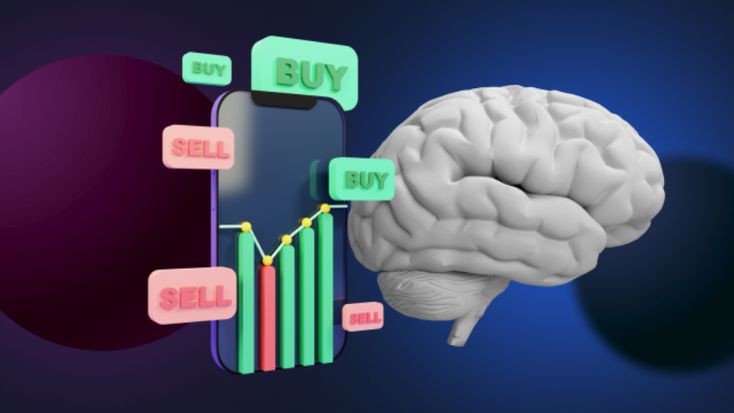
To understand emotional trading, you need to understand how the brain responds to money and risk. When you place a trade, your brain treats it the same way it treats a threat or a reward. Win, and dopamine spikes. Lose, and cortisol floods your system.
This is why losses feel twice as painful as wins feel good. Psychologists call this loss aversion, and it is hardwired into every human being. The market does not care about your wiring. But you have to.
The traders who win consistently are not emotionless. They are self-aware.They know their triggers. They know when fear is driving their decisions and when they are trading from a place of logic. That awareness is what separates a disciplined trader from an emotional one.
COMMON EMOTIONAL TRADING PATTERNS AND WHAT THEY REALLY MEAN

1.Revenge Trading: You take a loss and immediately open another trade to “win it back.” This is not strategy, this is ego. And it almost always leads to a bigger loss.
2.Overtrading: You feel the need to always be in a trade. Sitting on the sidelines feels like missing out. But the market does not owe you a setup every day, and forcing trades is one of the fastest ways to drain an account.
3.Moving Your Stop Loss: You set a stop loss, price moves toward it, and you widen it because you “believe in the trade.” What you are really doing is refusing to accept that you might be wrong. That refusal is expensive.
4.Early Exits: You are in profit, the trade is still valid, but you close it early because you are scared of giving back gains. Over time, this kills your risk-to-reward ratio and makes profitability almost impossible.
All of these patterns have one thing in common. They are responses to discomfort, not to data.
HOW SELF-AWARENESS TRANSFORMS YOUR TRADING

Self-awareness in trading is not about being hard on yourself. It is about being honest with yourself. It starts with asking better questions before, during, and after every trade.
Before the trade: Am I entering this because my criteria are met, or because I am bored, anxious, or chasing?
During the trade: Am I managing this trade according to my plan, or am I reacting to every candle?
After the trade: Win or lose, did I follow my process? What emotion was present and how did it influence my decision?
Over time, this kind of reflection builds a pattern of self-knowledge that is more valuable than any indicator or strategy. You start to see yourself clearly in the market, and that clarity is what makes consistency possible.
PRACTICAL STEPS TO MANAGE EMOTIONAL TRADING
1.Keep a trading journal: Document not just your entries and exits but howyou felt before and during each trade. Patterns will emerge, and thosepatterns will show you exactly where your psychology is costing you money.
2.Set rules and commit to them: A pre-trade checklist removes the space where emotions tend to operate. If your criteria are not met, you do not trade. Full stop.
3.Reduce your position size during losing streaks: Losses affect confidence. Smaller sizes during difficult periods protect your account and give yourpsychology room to recover.
4.Step away after three consecutive losses: This is a rule many professional traders swear by. Three losses in a row is a signal to pause, review, andreset, not to keep pushing.
5.Work with a mentor or trading community: Isolation makes emotional trading worse. Accountability and perspective from experienced traders can interrupt destructive patterns before they do serious damage. At Elevator, we pair traders with mentors who have been through the same psychological battles and come out the other side. Check it out here.
THE CHART IS A MIRROR: EMOTIONAL TRADING AND WHAT IT REVEALS

Here is the truth that most trading courses will not tell you. The chart does not just show you what the market is doing. It shows you who you are under pressure. Every impulsive entry, every moved stop loss, every revenge trade is a reflection of an unresolved emotional pattern.
The good news is that patterns can be changed. With the right awareness, the right structure, and the right support, you can become a trader who responds to the market rather than reacts to it. And that shift, from reaction to response, is where consistent profitability begins.
“The market will always be there. The question is whether the versionof you sitting at that screen is ready for it.”
Mastering the chart starts with mastering yourself. If you are ready todo that work, Elevator is ready to walk with you.
At Elevator, our Forex training goes beyond strategy. We help traders understand their psychology, build discipline, and develop the self-awareness that turns a struggling trader into a consistent one. Enroll here.
For further reading on trading psychology, visit here
Want to stay updated? Follow us on Instagram and X @joinelevators
